Several online journals and newspapers are concerned as well with this growing worldwide problem. An article on Crikey.com written by the former Australian Institute of Company Directors CEO Ian Dunlop vocalizes the importance of not only recognizing this problem, but points out several pieces of evidence that support their claims. Another article from the New American Journal, written by Ed Hiserodt, suggests that global warming is on the decline. An article written by Elizabeth Rosenthal in the New York Times gave suggestions on how to reduce your greenhouse gas emissions in your home. Andrew Revkin, another writer for the New York Times, wrote several online journals that pertain to this topic. In one he writes about a meeting that took place amongst some major nations that met to find a way to reduce their “carbon footprint”. Another one of his articles focuses on turning these harmful carbon emissions and turning them into something positive for the global community. In Revkin’s final article, he sheds some light on the other side of this issue. Revkin gives statistics and quotes from some oil industry leaders that state there is no problem with global warming. There are people who know about global warming and are doing positive things to reduce the rate of their emissions, but many still are far behind these few groups of people.
Though many uneducated people don’t know what global warming is, it is a very elementary thing to others. Global warming is caused by releasing too many carbon molecules into the atmosphere. Carbon can be released many different ways. One of the ways we do without even thinking about: this is the burning of fossil fuels; so everyday when you drive to work or school or just down the street think about how you are a part of the problem, not the solution. Lately, the hot topic in this subject is measuring your “carbon footprint”. A carbon footprint is a hypothetical term that simply means the imprint you leave behind with the use and release of carbon molecules. Both companies and homes should try and monitor their “carbon footprint”, to see if they can decrease the magnitude of their devastation on the environment. For example, Elizabeth Rosenthal of the New York Times suggested “behavioral changes, like carpooling, insulating their homes and drying clothes outside instead of in a tumble dryer” (Rosenthal). Companies, as well as individuals, create their own “carbon footprint.” In a recent article for The New York Times, Revkin writes about a meeting amongst large nations who are looking for a way to shrink their “carbon footprint.” Revkin speaks about the Obama Administration and their efforts to reduce global warming worldwide. In this article, Prime Minister Gordon Brown of Britain was quoted when he said “We cannot compromise with the catastrophe of unchecked climate change, so we must compromise with one another” (Revkin). Recently, there has been a spark in the awareness of global warming by the media. A large coalition group called Consequnce09 has been a key factor for the increase of awareness. Their mission statement is:
Through an intensive grassroots effort to educate, organize, mobilize these young voters, the partners of the Consequence campaign will ensure that Americans know that young people demand a commitment to a clean energy economy that creates millions of clean energy jobs, reduces our dependence on foreign oil and curbs dangerous global warming pollution. (Consequence09 1)
This site emphasizes the importance of youth involvement and is sponsored with several other youth-based groups including Rock the Vote, a voting awareness group focused for the youth of America. Consequence09 says the reason the youth need to be involved is because “youth have the most to lose from the impending climate catastrophe, and the most to gain from a new clean energy economy” (Consequence 1). Their website, www.consequence09.org, is primarily a website creating awareness and publicity from what seems to be a government-sponsored agency.
Barack Obama narrates a short video that emphasizes the need for raised awareness for this issue.
Barack Obama narrates a short video that emphasizes the need for raised awareness for this issue. According to Consequence09’s website the reason for pursuing the youth’s strong support for this worldwide issue is because the youth:
Understand that we must pursue a “Yes We Can” approach to our nation’s climate and energy challenges, and that there are real consequences—for our economy, our security and the future of our planet—if our nation fails to act. (Consequence09)
Even if it means “going the extra mile” or taking the time out of our schedule to reduce our effect on the world, I strongly believe we, as a global community and fellow inhabitants of the same world, should do it.
Should the government be encouraging people to reduce their carbon output at home? Global warming is a growing concern, but should tax breaks and other incentives be offered? Rosenthal certainly believes so. She states one solution to this problem which is “offering simpler and more immediate financial incentives for insulating a home or buying an energy-efficient appliance” (Rosenthal). Offering incentives for “going green” should not be frowned upon. Though the governments of society have enough debt to keep them busy for awhile, this small increase to our debt would be well worth it. There has been talk amongst reporters and scientist about the idea of taking this resource (carbon dioxide) and turning it into a commodity. Revkin, in his article about using carbon dioxide for good instead of evil, talks about an idea for using this terrible happening into something everyone could better them with. He responds by saying:
Through a so-called cap and trading system, those making extra-deep cuts in emissions can profit by selling what amounts to their extra credit to those who cannot afford to cut their own gas releases so deeply or quickly. (Revkin)
This is just one of the many ideas by both scientists and well-known journalists. Other ideas include eating less meat. Though this seems a bit farfetched, it is a well known fact that cows produce methane gas. By eating less meat we can change the food we give to them which would affect their “output” of their own carbon emission. Humorous as this topic may be, this is just another idea that Revkin gives as a solution to global warming.
Also in recent history, a researcher by the name of Al Gore did extensive work in this field of work. He did research and presented his work from the late 1990s to the early 2000s that followed. It is not until recently did he receive the attention and credibility that he deserved. In 2006, Al Gore helped produce a movie titled An Inconvenient Truth. This historic documentary was about global warming and how this problem is affecting the Earth and how the world could change if we do not fix this problem.
It is not until recently did he receive the attention and credibility that he deserved.
Al Gore is a very staunch Democrat with many strong liberal views, and as Andrew Revkin described him in his article,
Mr. Gore remains in the all-of-the-above camp, seeking both a tax on carbon dioxide emissions and endorsing, somewhat guardedly, the “cap and trade” architecture favored by congressional Democrats and many large environmental groups. (Revkin)
This helped mainstream the desire to find a solution to global warming throughout the world. He, more recently, put out his third book titled “Our Choice: A Plan to Solve the Climate Crisis.” Though I did not get the chance to read his new book, Andrew Revkin of The New York Times summarizes it as “mainly a heavily illustrated guide to the technologies and policies that could, in Mr. Gore’s view, limit climate dangers” (Revkin). Al Gore has already done a tremendous amount for publicizing global warming, and there it really looks as if he has no intentions of slowing down anytime soon.
Natural disasters are something that cannot be avoided, no matter how hard we try. Global warming is only increasing these terrible occurrences. As the temperature increases, different kinds of fronts move and collide with each other more rapidly and destructively.

Hurricane Katrina “killed 1500 people and devastated the city of New Orleans” (Dunlop).This creates larger hurricanes, tsunamis, and even tornados. Also in recent history, the city of New Orleans was almost completely wiped off the map by hurricane Katrina. According to Dunlop, Hurricane Katrina “killed 1500 people and devastated the city of New Orleans” (Dunlop). On the other side of the world, a massive tsunami killed thousands in India and the Philippines. Dunlop even points out a few natural disasters that some have overlooked. It states-
Cyclone Nargis in Myanmar last year killed some 78,000 people with millions homeless; Cyclone Sidr in Bangladesh in 2007 killed some 3000 people and destroyed 500,000 homes. (Dunlop)
Environmental scientists and meteorologists have concurred that this was directly caused by global warming. Not only is global warming affecting our environment, but its taking human lives. If we, as human beings, do not have the drive to find a solution to this growing problem, we have no one to blame but ourselves.
Humans are not the only species that are affected by this problem with our environment. Green house gases that are causing global warming are causing a global climate change. According to Dunlop:
The immediate concern is the rapid summer melt of Arctic sea-ice and the increasing evidence of methane hydrate and permafrost carbon dioxide emissions. If this takes off, global warming will probably move beyond our control, with catastrophic consequences. (Dunlop)

The polar ice caps, which were once home to many different species, are melting. Some may say this does not pertain to the human species, so we as a global community should not worry about the animals; I wish to counter this widespread idea. The loss of habitat is forcing many animals to lose their hunting grounds and migrate to a new location. Many of the animals that once called this home are now left with no habitat or food. This creates the problem of overcrowding of animals, the depletion of species, and scarce food sources for all other animals. Think of it this way: the polar bears’ main sources of food are penguins. If the polar bears leave their depleting habitat, not as many penguins are eaten which causes overpopulation of penguins. Then, the penguins’ main sources of food are fish. The penguins, since there are now more of them, have to eat more of the fish population. Perhaps, in this area, this is where North American fishermen get the majority of their collection of fish every year. This would either cause a poor fishing season or the endangerment of the penguins; it all depends who gets to the fish first. In a way, the animals’ problems from global warming become our problem. This is just another reason why global warming needs a solution as soon as possible.
Even after knowing all the facts about how much harm global warming is doing, some people choose not to participate as a part of the solution. Given that burning fossil fuels in ways such as gasoline for energy is such an everyday way of life, many are reluctant to change their ways.

Given that burning fossil fuels in ways such as gasoline for energy is such an everyday way of life, many are reluctant to change their ways.According to Consequences09, they say:
Lobbyists for oil and coal companies want to kill climate change legislation in Congress right now, because their clients get rich keeping things the way they are, even though our military and intelligence leaders know climate change will create a series of wars around the world.
These people who continue to push against this legislation that is supposed to help global warming are hurting both America and the entire Earth. Just because a few people in the world want to line their pockets with money, they are willing to sacrifice the well being of every human being and animal on this planet. That is not only disgusting but it is a crime against humanity. Some say reducing carbon emissions would cost billions of dollars and would only increase the United States’ national deficit. On the other hand, Hiserodt suggests that global warming is finally on the decline. He supports his claim when he says-
Satellite data from NASA shows no increase in average global temperature since 1998, a year when El Niño caused a worldwide spike having nothing to do with carbon dioxide. Alarmists contend this is just a pause in a continuous rise in temperatures and that it will begin to increase again. (Hiserodt 1)
Even with the NASA data, it is still difficult to not want to do something about this global problem. Though Hiserodt claims that carbon dioxide emissions are not linked to the increase in temperature, several other sources disagree.
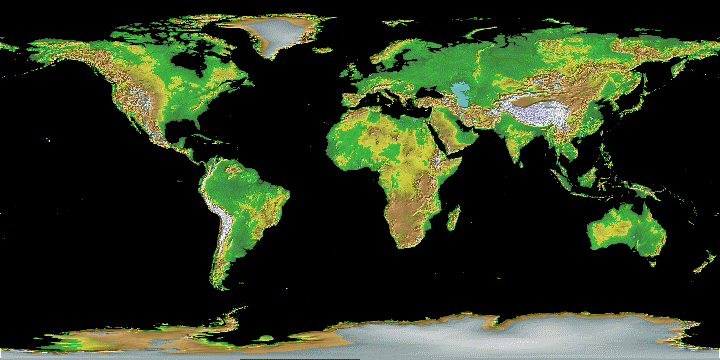
The status quo, as it stands now, is terrible. Global warming is only getting worse every year that passes. There are plenty of ways that we can find solutions to the growing problem; the technology is out there. We, as a global community, just need to show the desire to want to better our world. But if we don’t, the percentage of 60% water and 40% land could increase to astounding 70% water and 30% land. This could increase urban crowding. This would increase many problems we already have, such as disease and crime.
Works Cited
CO2SEQUENCE09. Consequence09. Consequence Campaign, 2009. Web. 15 Nov. 2009.
Dunlop, Ian. “Global Warning is a Global Emergency.” Crikey. Web. 25 Feb. 2009
Hiserodt, Ed. “A Cooling Trend toward Global Warming.” New American 25.8. 21-23. Web. 25 Sept. 2009.
Revkin, Andrew C. “A Greenhouse Gas That Is Already a Commodity.” DotEarth. Web. 14 Oct. 2009.
In this article, Andrew Revkin brings up the topic of carbon dioxide. Carbon dioxide is one of the leading causes for global warming, so Revkin pursues an idea on how we can turn this negative product into something good for the United States.
Revkin, Andrew C. “Al Gore’s Climate Change.” DotEarth. Web. 3 Nov. 2009.
Revkin, Andrew C. “On CO2, Small Step for Big Emitters?” DotEarth. Web. 30 Oct. 2009.
Andrew Revkin writes about a meeting that took place that was about energy and the climate. In this article Revkin focuses on the importance of reducing carbon dioxide emissions and how major companies are taking part to try and reduce their “carbon footprint”.
Revkin, Andrew C. “‘Striving for No’ in Climate Talks.” DotEarth. Web. 14 Oct. 2009.
Revkin throws around several ideas in this article that pertain to the idea that global warming is not an issue. He brings up facts and quotes from several Arabian oil industry leaders that point out that they do not think global warming is an issue. Personally, I believe this is because their largest and most important export is one of the main causes for global warming.
Rosenthal, Elizabeth. “How U.S. Households Could Cut Emissions of Greenhouse Gases.” New York Times. Web. 28 Oct. 2009

Nice post and revision work.
ReplyDelete